
B-hIL22/hIL22RA1/hIL10RB mice
C57BL/6-Il22tm1(IL22)Bcgen Il22ra1tm1(IL22RA1)Bcgen Il10rbtm1(IL10RB)Bcgen/Bcgen • 113344

B-hIL22/hIL22RA1/hIL10RB mice

Catalog Number
113344
Strain Name
C57BL/6-Il22tm1(IL22)Bcgen Il22ra1tm1(IL22RA1)Bcgen Il10rbtm1(IL10RB)Bcgen/Bcgen
Strain Background
C57BL/6
NCBI gene ID
Aliases
IL-21, IL-22, IL-D110, IL-TIF, ILTIF, TIFIL-23, TIFa, zcyto18; CRF2-9, IL22R, IL22R1; CDW210B, CRF2-4, CRFB4, D21S58, D21S66, IBD25, IL-10R2, IL-10RB

on this page

  • Description
  • Phenotypic analysis

Posters

View All

    Publication

      Description

      IL-22 has a specialized role as a crucial bridge between the immune system and epithelial barrier tissues, regulating both tissue defense and homeostasis. 

      • Gene Information: IL22 encodes interleukin-22, a pro-inflammatory cytokine in the IL-10 family that functions in antimicrobial defense, tissue repair, and inflammatory responses. It acts on non-immune cells rather than immune cells, making its activity centered on epithelial tissues and barrier protection. 
      • Protein Expression: IL-22 is primarily produced by specialized immune cells, most notably Th17 cells, Th22 cells, and group 3 innate lymphoid cells (ILC3s). Its expression is strongly induced by IL-23 and is typically a response triggered by the presence of extracellular pathogens or tissue injury at mucosal and skin barriers. 
      • Signaling Pathway: IL-22 stimulation activates the JAK1 and TYK2 kinases, which subsequently leads to the phosphorylation and activation of STAT3 (and to a lesser extent, STAT1 and STAT5). This cascade induces the transcription of genes involved in producing antimicrobial peptides (AMPs), promoting cellular proliferation, and enhancing tissue repair. 
      • Therapeutic Inhibition: Inhibiting IL-22 signaling helps suppress abnormal tissue proliferation and inflammation in skin diseases like psoriasis. Conversely, IL-22 agonists are being developed to promote mucosal healing and tissue regeneration in conditions like inflammatory bowel disease.
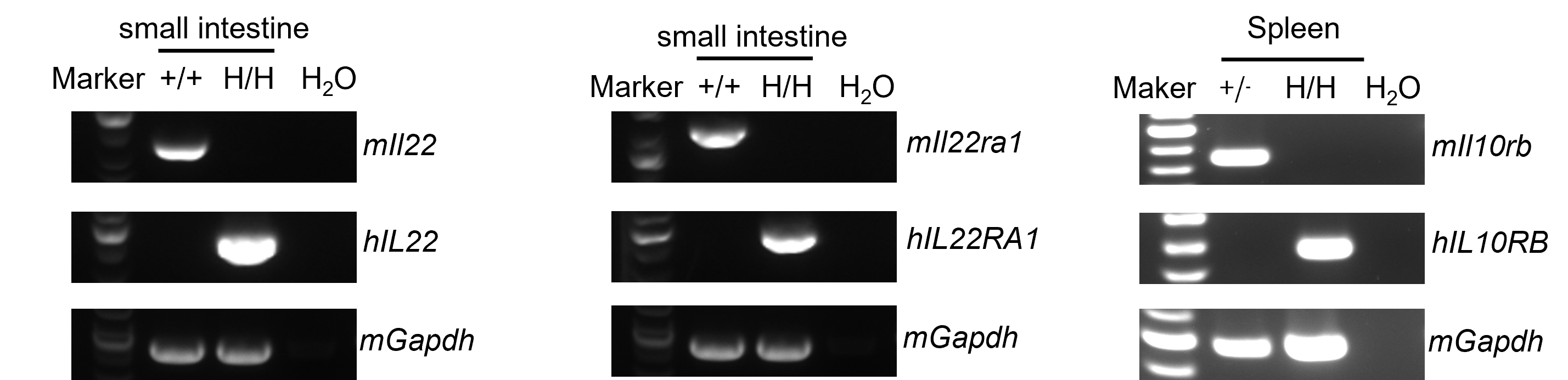
      Human IL22, IL22RA1, IL10RB mRNA Expression Analysis in Small Intestine And Spleen of IL22/IL22RA1/IL10RB Humanized Mice
      • Human IL22, IL22RA1, IL10RB mRNA was detectable only in homozygous IL22/IL22RA1/IL10RB humanized mice , but not in wild-type C57BL/6JNifdc mice.

      Species specific analysis of IL22, IL22RA1, IL10RB gene expression in wild-type C57BL/6JNifdc mice and homozygous IL22/IL22RA1/IL10RB humanized mice by RT-PCR. Small intestine and splenocytes were collected from wild-type C57BL/6JNifdc mice (+/+) and homozygous B-hIL22/hIL22RA1/hIL10RB mice (H/H, H/H,H/H). Mouse Il22, Il22ra1, Il10rb mRNA was detectable only in wild-type C57BL/6JNifdc mice. Human IL22, IL22RA1, IL10RB mRNA was detectable only in homozygous B-hIL22/hIL22RA1/hIL10RB mice, but not in wild-type C57BL/6JNifdc mice. The positive band was confirmed to be correct by sequencing.
      Human IL22 Protein Expression Analysis in Serum of IL22/IL22RA1/IL10RB Humanized Mice
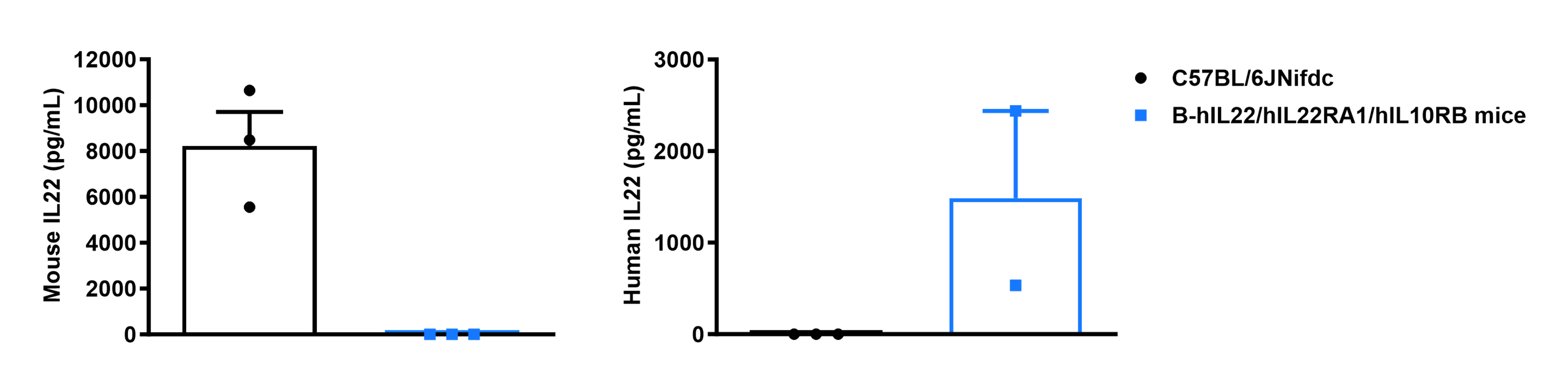
      • Mouse IL22 was only detectable in wild-type C57BL/6 mice.
      • Human IL22 was exclusively detectable in homozygous IL22/IL22RA1/IL10RB humanized mice.

      Strain specific IL22 expression analysis in wild-type C57BL/6JNifdc mice and homozygous IL22/IL22RA1/IL10RB humanized mice by ELISA.
      Serum was collected from wild-type C57BL/6JNifdc mice (female, n=3, 6-7-week-old) and homozygous B-hIL22/hIL22RA1/hIL10RB mice (female, n=2, 6-7-week-old)stimulated with anti-mouse CD3ε antibody (7.5 μg/mouse, i.p.) and anti-mouse CD28 antibody (5 μg/mouse, i.p.) in vivo for 3 hours. Expression level of mouse andhuman IL22 were analyzed by ELISA (anti-mouse IL22 antibody: Abcam, ab223857; anti-human IL22 antibody: Abcam, ab216170). Mouse IL22 was only detectable in wild-type mice. Human IL22 was exclusively detectablein homozygous B-hIL22/hIL22RA1/hIL10RB mice. Values are expressed as mean ± SEM.
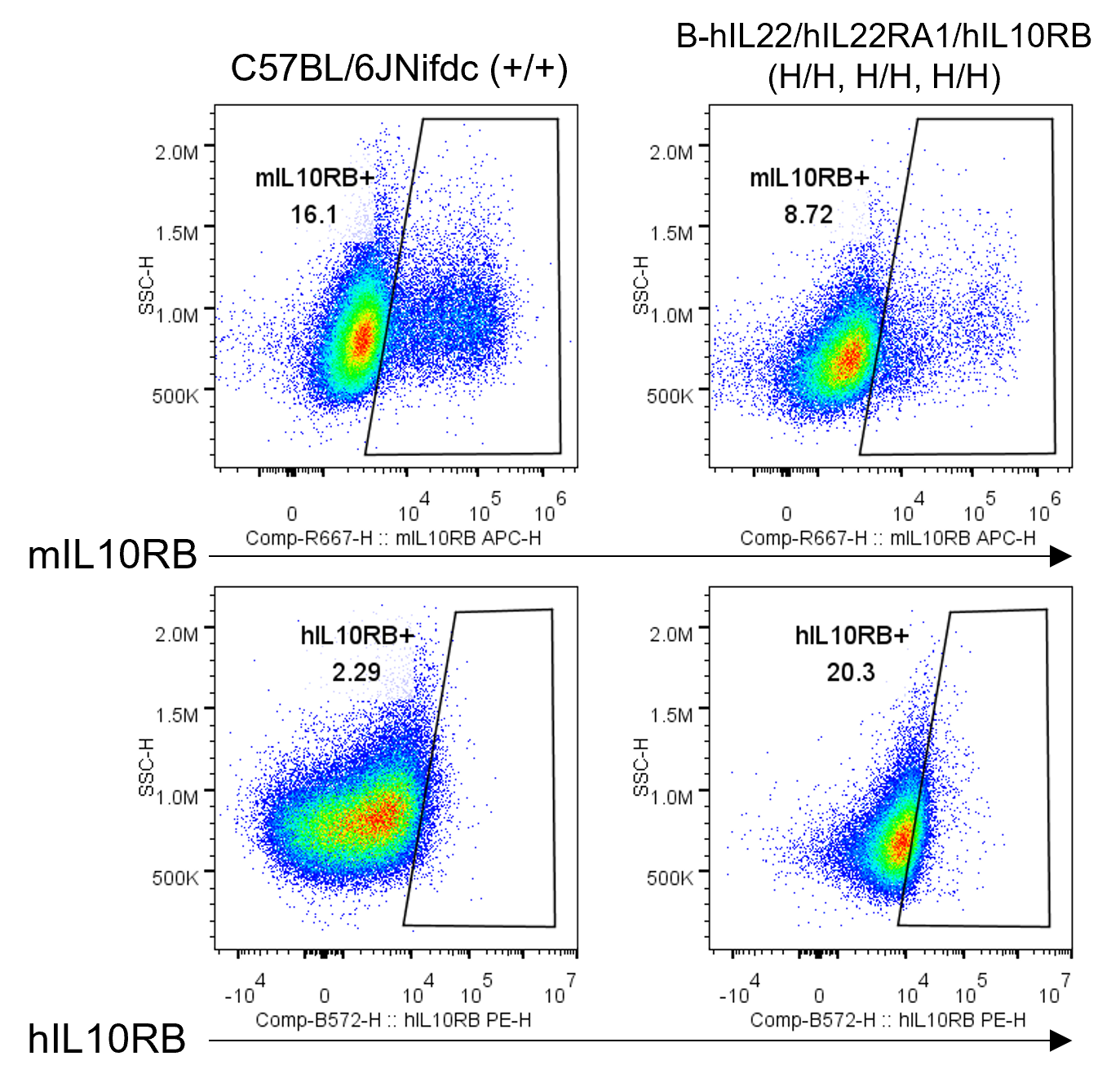
      Human IL10RB Protein Expression Analysis in Peritoneal Exudative Macrophages of IL22/IL22RA1/IL10RB Humanized Mice
      • Mouse IL10RB was detectable in wild-type C57BL/6JNifdc mice and homozygous  IL22/IL22RA1/IL10RB humanized mice due to the cross-reactivity of antibodies. 
      • Human IL10RB was detectable in homozygous IL22/IL22RA1/IL10RB humanized mice.

      Strain specific IL10RB expression analysis in homozygous IL22/IL22RA1/IL10RB humanized mice by flow cytometry. Peritoneal exudative macrophages were collected from wild-type C57BL/6JNifdc mice and homozygous B-hIL22/hIL22RA1/hIL10RB mice, protein expression was analyzed by flow cytometry with anti-mouse IL10RB antibody (R&D, FAB53681A) and anti-human IL10RB antibody (Biolegend, 396803). Mouse IL10RB was detectable in wild-type C57BL/6JNifdc mice and homozygous B-hIL22/hIL22RA1/hIL10RB mice due to the cross-reactivity of antibodies. Human IL10RB was detectable in homozygous B-hIL22/hIL22RA1/hIL10RB mice.
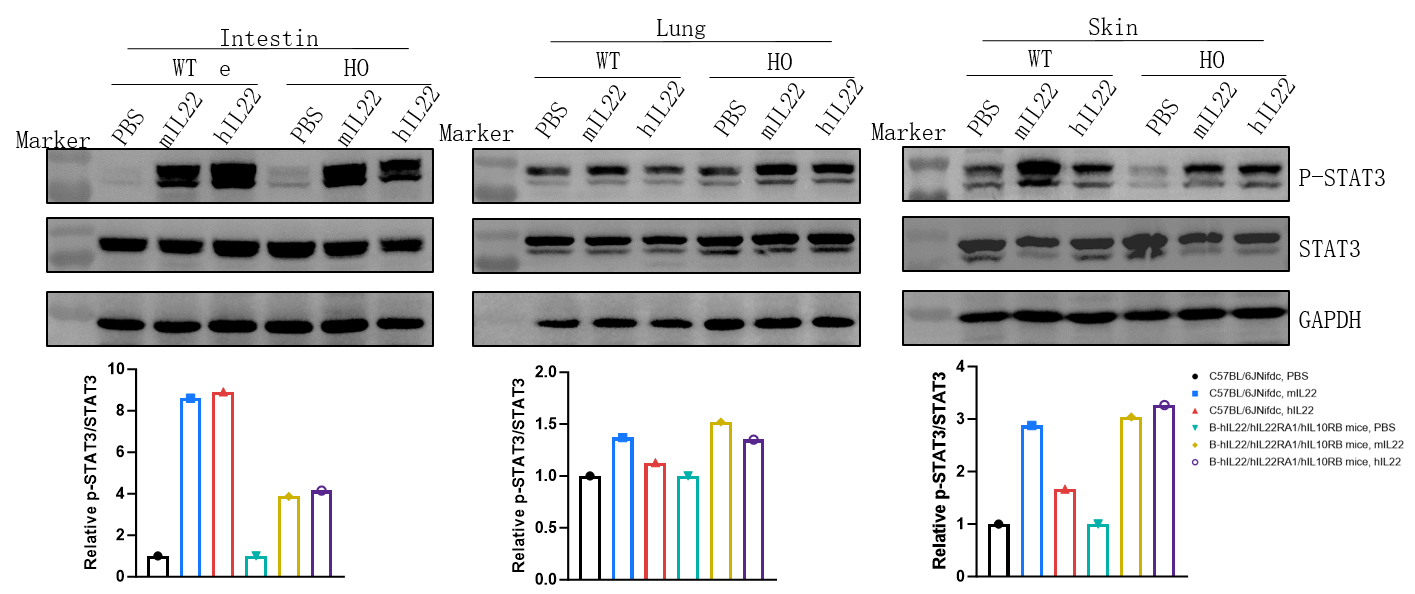
      Functional validation-p-STAT3 expression analysis in IL22/IL22RA1/IL10RB Humanized Mice
      • In both wild-type mice and  IL22/IL22RA1/IL10RB humanized mice, p-STAT3 expression was increased in the intestine, lungs and skin after mIL-22 and hIL22 stimulation, and hIL22 exhibits weaker affinity for wild-type mice in lung and skin.
      • The signaling pathway functions normally in IL22/IL22RA1/IL10RB humanized mice.

      Strain specific p-STAT3 expression analysis in wild-type C57BL/6JNifdc mice and homozygous IL22/IL22RA1/IL10RB humanized mice by western blot. Intestine, lung and skin were collected from wild-type C57BL/6JNifdc mice (+/+) and homozygous B-hIL22/hIL22RA1/hIL10RB mice (H/H; H/H; H/H), which were stimulated with PBS, mIL22 or hIL22 and analyzed by western blot with mouse p-STAT3 Antibody (CST, 9145T) and STAT3 Antibody (CST, 9139T). In both wild-type mice and B-hIL22/hIL22RA1/hIL10RB mice, p-STAT3 expression was increased in the intestine, lungs and skin after mIL-22 and hIL22 stimulation, and hIL22 exhibits weaker affinity for wild-type mice in lung and skin. WT: wild-type C57BL/6JNifdc mice; HO: homozygous B-hIL22/hIL22RA1/hIL10RB mice.

      * When publishing results obtained using this animal model, please acknowledge the source as follows: The animal model [B-hIL22/hIL22RA1/hIL10RB mice] (Cat# 113344) was purchased from Biocytogen.