


IL-17A: A key pro-inflammatory cytokine in autoimmune skin and joint diseases.
Gene Information: The IL17A gene (also known as CTLA8) is a protein-coding gene located on chromosome 6p12.2. This cytokine is the founding member of the IL-17 family and primarily signals through a heterodimeric receptor complex composed of IL-17RA and IL-17RC.
Protein Expression: IL-17A is predominantly produced by specialized CD4+ T cells Th17 cells), as well as various innate immune cells, innate lymphoid cells (ILC3s), and neutrophils. It exists primarily as a secreted, disulfide-linked homodimer (IL-17A/A) or as a heterodimer with IL-17F (IL-17A/F).
Signaling Pathway: Upstream IL-17A production is driven by the IL-23/Th17 axis. Downstream IL-17A binds to the IL-17RA/IL-17RC complex on target cells (e.g., keratinocytes), recruiting Act1 to activate NF-κB and MAPKs.
Therapeutic Inhibition: Blocking IL-17A or its interaction with its receptors dramatically reduces inflammatory responses. Therapeutic monoclonal antibodies targeting this axis are highly effective and for autoimmune conditions such as plaque psoriasis, psoriatic arthritis, and ankylosing spondylitis.

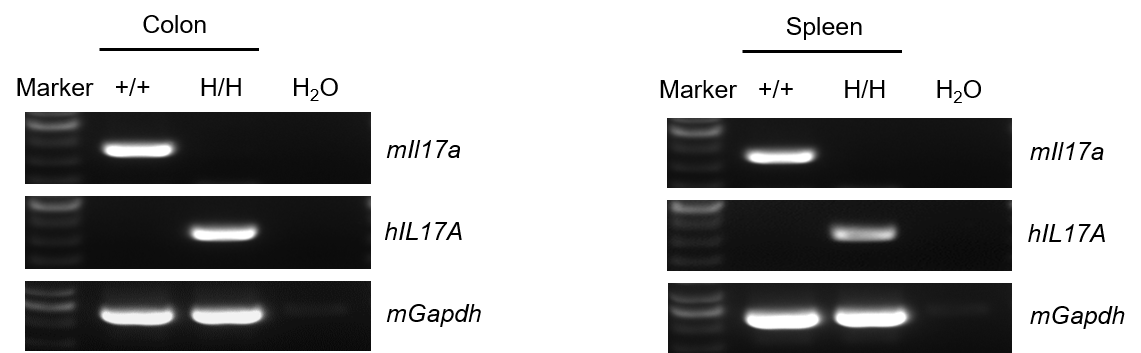
Strain specific analysis of IL17A mRNA expression in BALB/cCrSlcNifdc mice and homozygous IL17A humanized (C) by RT-PCR. Colon and spleen were collected from wild-type BALB/cCrSlcNifdc mice (+/+) and homozygous B-hIL17A mice (C) (H/H) stimulated with anti-mouse CD3ε antibody (7.5 μg/200uL, i.p.) and anti-mouse CD28 antibody (4 μg/200uL, i.p.) in vivo for 2 hours. Mouse Il17a mRNA was detectable only in wild-type mice. Human IL17A mRNA was detectable only in homozygous B-hIL17A mice (C), but not in wild-type mice.
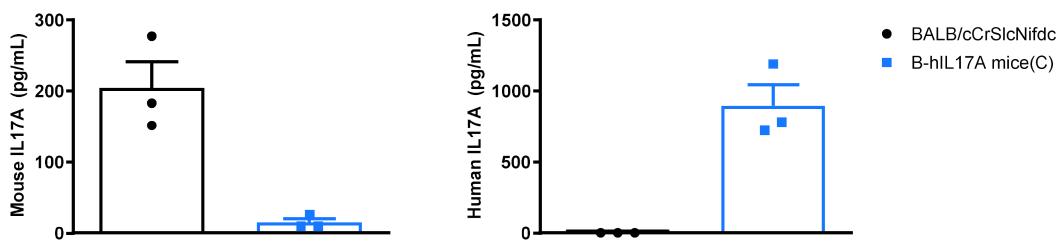
Strain specific IL17A expression analysis in wild-type BALB/cCrSlcNifdc mice and homozygous IL17A humanized mice (C) by ELISA. Serum was collected from wild-type BALB/cCrSlcNifdc mice (+/+) and homozygous B-hIL17A mice (C) (H/H) stimulated with anti-mouse CD3ε antibody (7.5 μg/200uL, i.p.) and anti-mouse CD28 antibody (4 μg/200uL, i.p.) in vivo for 2 hours (female, 9-week-old, n=3). Expression levels of mouse and human IL17A were analyzed by ELISA (anti-mouse IL17A antibody: ProteinTech, KE10020; anti-human IL17A antibody: Biolegend, 433917). Mouse IL17A was detectable in wild-type mice. Human IL17A was detectable in homozygous B-hIL17A mice (C). Values are expressed as mean ± SEM.