Description
IL-36R: A key pro-inflammatory receptor in autoimmune skin and barrier diseases
- Gene Information: The IL1RL2 gene (commonly known as IL-36R) is a protein-coding gene located on chromosome 2q12.1. This receptor is a member of the IL-1 receptor family and primarily signals through a heterodimeric receptor complex composed of IL-36R and the IL-1 receptor accessory protein (IL-1RAcP).
- Protein Expression: IL-36R is predominantly expressed by epithelial cells (especially skin keratinocytes), as well as mucosal barrier cells in the respiratory and intestinal tracts. It is also expressed on various immune cells, including dendritic cells (DCs), macrophages, and naive CD4+ T cells.
- Signaling Pathway: Upstream activation is driven by the binding of IL-36 agonists (IL-36α, IL-36β, or IL-36γ) to IL-36R, which then recruits the co-receptor IL-1RAcP. Downstream, this trimeric complex recruits the adaptor protein MyD88 to activate NF-κB and MAPK pathways, driving the robust production of pro-inflammatory cytokines and chemokines.
- Therapeutic Inhibition: Therapeutic monoclonal antibodies targeting this receptor are highly effective and clinically approved for severe autoinflammatory conditions such as generalized pustular psoriasis (GPP).
Human IL36R mRNA Expression Analysis in IL36R Humanized Mice (BALB/c)
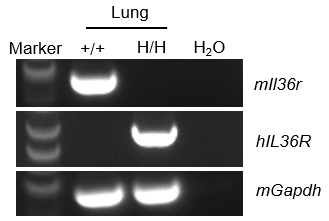
- Mouse Il36r mRNA was only detectable in wild-type mice.
- Human IL36R mRNA was exclusively detectable in homozygous IL36R humanized mice (C) but not in wild-type mice.
Strain specific analysis of IL36R mRNA expression in BALB/cCrSlcNifdc mice and homozygous IL36R humanized mice (C) by RT-PCR. Lung RNA was isolated from BALB/cCrSlcNifdc mice (+/+) and homozygous B-hIL36R mice (C) (H/H), then cDNA libraries were synthesized by reverse transcription, followed by PCR with mouse or human IL36R primers. Mouse Il36r mRNA was only detectable in wild-type mice. Human IL36R mRNA was exclusively detectable in homozygous B-hIL36R mice (C) but not in wild-type mice.
In Vivo Efficacy of Anti-human IL36R Antibodies in Psoriasis Model Induced in IL36R Humanized Mice (BALB/c)
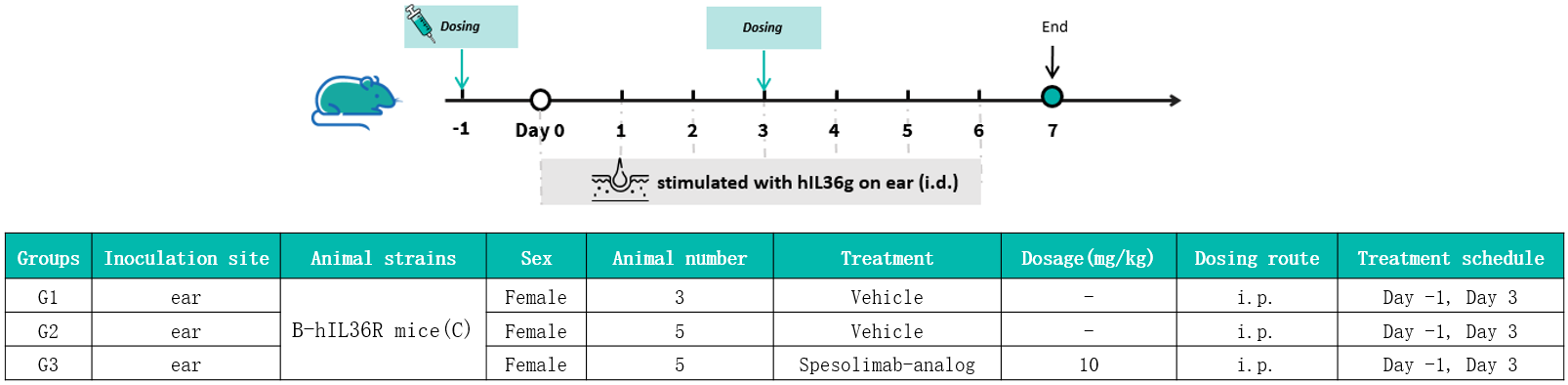
Experimental schedule for IMQ-induced psoriasis model in IL36R humanized mice (C). Mice at 12 week-old of age received a daily topical of commercially hIL36γ on ear for 7 consecutive days to induce psoriasis model. Control mice were treated similarly with PBS.
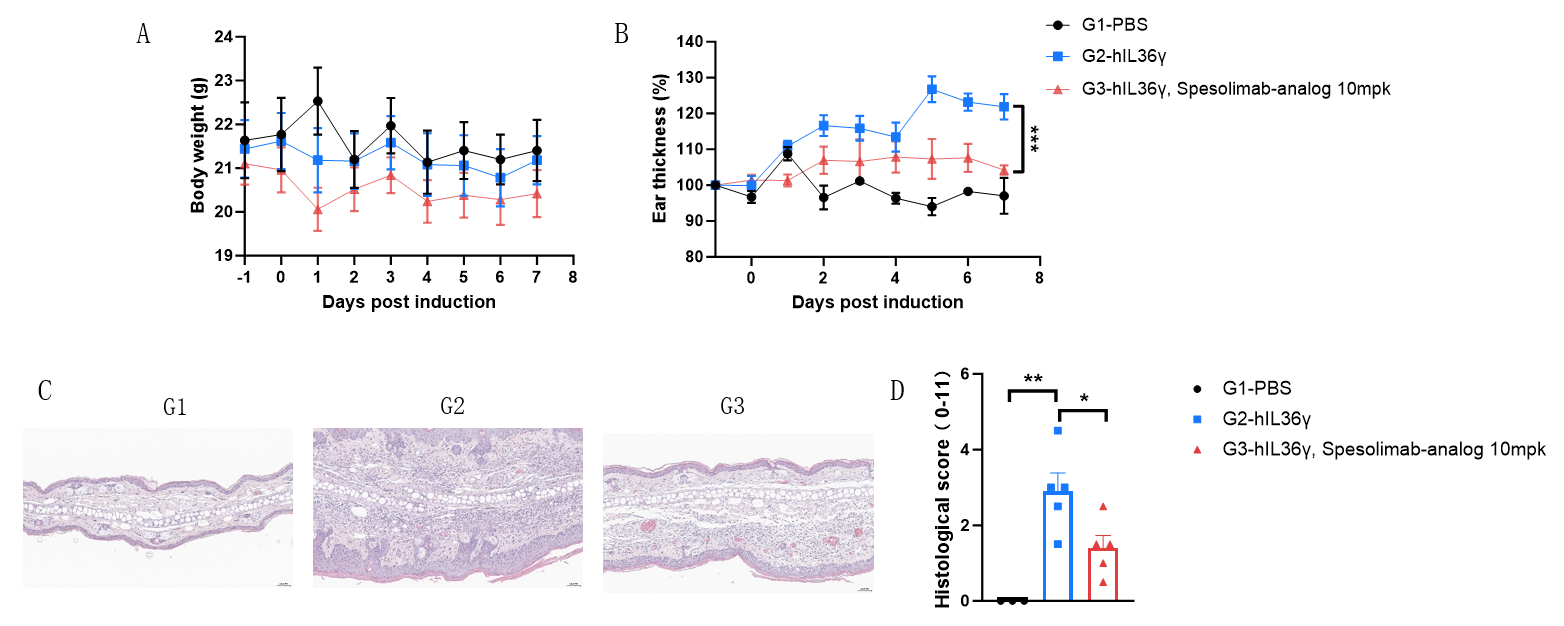
- Spesolimab-analog had therapeutic effects on psoriasis in IL36R humanized mice (C).
- IL36R humanized mice (C) provides a powerful model for in vivo evaluation of anti-human IL36R antibody.
IL36γ-induced psoriasis model in IL36R humanized mice. Mice (female, 12 week-old, n=5) were scored daily for up to 7 days for body weight and clinical signs of skin inflammation following treatment with IL36γ. Mice in each group were treated with different doses of Spesolimab-analog (in house). Ears were collected at the endpoint and stained with Hematoxylin and eosin (H&E). (A) Body weight during treatment. (B) Ear thickness changes during treatment. (C) H&E staining of the ear. (D) Histological changes were scored. Results indicated that Spesolimab-analog (in house) had therapeutic effects on psoriasis in B-hIL36R mice(C), confirming that B-hIL36R mice(C) provides a powerful model for in vivo evaluation of anti-human IL36R antibody. Values are expressed as mean ± SEM.
* When publishing results obtained using this animal model, please acknowledge the source as follows: The animal model [B-hIL36R mice(C)] (Cat# 113498) was purchased from Biocytogen.