Description
CD3EDG/CD2: A synergistic T-cell receptor and costimulatory signaling complex.
- Gene Information: This multi-gene combination clusters CD3E, CD3D, and CD3G on chromosome 11q23, paired with CD2 located on chromosome 1p13, establishing a critical, multi-chromosomal T-lineage genomic target panel.
- Protein Expression: All components of the CD3EDG complex and the CD2 glycoprotein are highly, concurrently, and selectively expressed on the surface of mature peripheral T lymphocytes and developing thymocytes.
- Signaling Pathway: CD3EDG mediates primary antigen recognition via ITAM phosphorylation and ZAP70 recruitment, while CD2 co-engagement synergistically amplifies these cascades, optimizing calcium flux and downstream IL-2 transcriptional activation.
- Therapeutic Inhibition: Targeting this dual panel allows the development of next-generation multi-specific antibodies or CAR-T cells that exploit CD2 costimulation alongside CD3 activation to maximize anti-tumor effector functions.
Targeting strategy
CD3EDG
- The human CD3EDG was expressed, while mouse Cd3edg were knocked out in B-hCD3EDG/hCD2 mice.
CD2
- The exons 1-4 of mouse Cd2 gene that encode signal peptide and extracellular domain were replaced by human counterparts in B-hCD3EDG/hCD2 mice.
- The genomic region of mouse Cd2 gene that encodes transmembrane domain and cytoplasmic portion was retained. The promoter, 5’UTR and 3’UTR region of the mouse gene were also retained. The chimeric CD2 expression was driven by endogenous mouse Cd2 promoter, while mouse Cd2 gene transcription and translation will be disrupted.
B-hCD3EDG/hCD2 mice (113866) were obtained by mating B-hCD3EDG mice (110039) and B-hCD2 mice (111132).
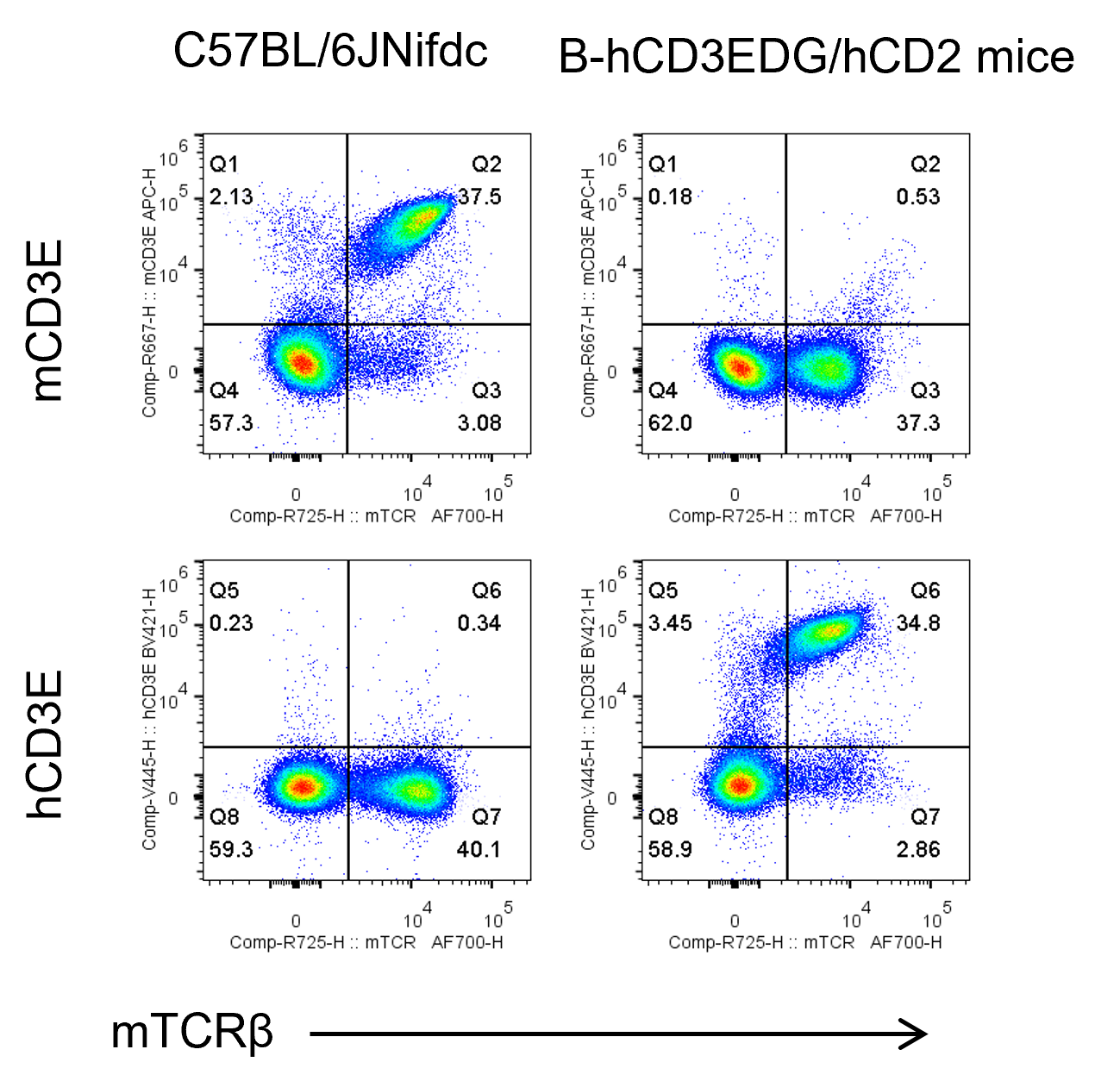
CD3E Protein Expression in Spleen
- Mouse CD3E was detectable on T cells in spleen of wild-type C57BL/6JNifdc mice.
- Human CD3E was detectable on T cells in spleen of homozygous B-hCD3EDG/hCD2 mice, but not in wild-type C57BL/6JNifdc mice.
Strain specific CD3E expression analysis in wild-type C57BL/6JNifdc mice and homozygous humanized B-hCD3EDG/hCD2 mice by flow cytometry. Splenocytes were collected from wild-type C57BL/6JNifdc mice and homozygous B-hCD3EDG/hCD2 mice. Protein expression was analyzed with anti-mouse CD3E antibody (Biolegend, 100312) and anti-human CD3E antibody (BD, 562426) by flow cytometry.
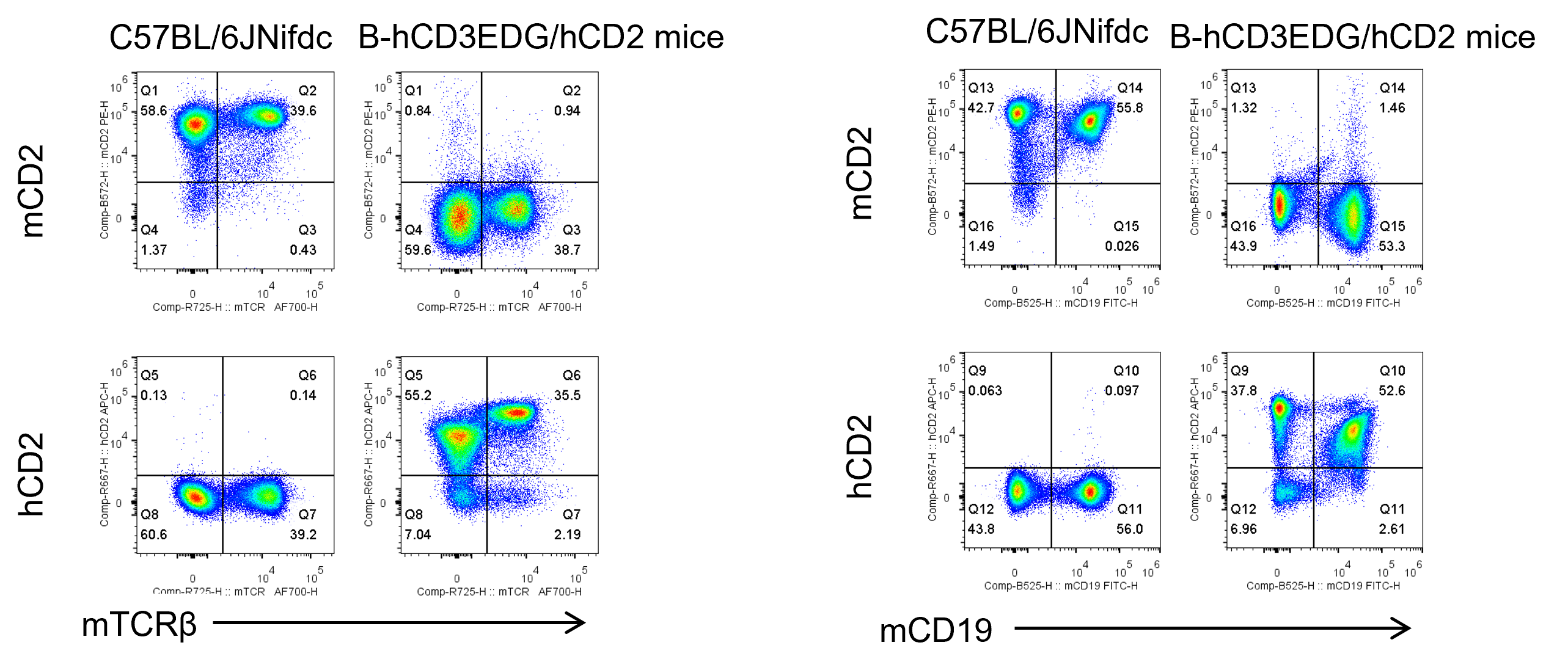
CD2 Protein Expression in Spleen
- Mouse CD2 was detectable on T cells and B cells in spleen of wild-type C57BL/6JNifdc mice.
- Human CD2 was detectable on T cells and B cells in spleen of homozygous B-hCD3EDG/hCD2 mice, but not in wild-type C57BL/6JNifdc mice.
Strain specific CD2 expression analysis in wild-type C57BL/6JNifdc mice and homozygous humanized B-hCD3EDG/hCD2 mice by flow cytometry. Splenocytes were collected from wild-type C57BL/6JNifdc mice and homozygous B-hCD3EDG/hCD2 mice. Protein expression was analyzed with anti-mouse CD2 antibody (Biolegend, 100107) and anti-human CD2 antibody (Biolegend, 300213) by flow cytometry.
* When publishing results obtained using this animal model, please acknowledge the source as follows: The animal model [B-hCD3EDG/hCD2 mice] (Cat# 114673) was purchased from Biocytogen.