Description
CLEC9A: A cDC1-associated C-type lectin receptor and target for antigen delivery
- Gene Information: CLEC9A (encoding CD370, also known as DNGR-1) is a protein-coding gene located on chromosome 12p13.2. It encodes C-type lectin domain family 9 member A, a cell-surface transmembrane receptor belonging to the C-type lectin-like receptor (CTLR) family.
- Protein Expression: CLEC9A is selectively expressed on cells of the dendritic cell lineage, specifically type 1 conventional dendritic cells (cDC1s). It is not broadly expressed on circulating monocytes, macrophages, neutrophils, or other major leukocyte populations.
- Signaling Pathway: CLEC9A transduces signals by binding exposed filamentous actin (F-actin) from necrotic cells and engaging an intrinsic cytoplasmic hemi-ITAM (hemITAM) motif to trigger downstream Syk kinase cascades.
- Therapeutic Inhibition: CLEC9A-targeted antibodies and antigen-conjugated constructs deliver tumor or pathogen antigens to cDC1s, promoting antigen cross-presentation and antigen-specific CD8+ T-cell responses. Combination with adjuvants or immunostimulatory agents is investigated to enhance immune priming and antitumor activity.
Human CLEC9A Protein Expression Analysis in Spleen of CLEC9A Humanized Mice
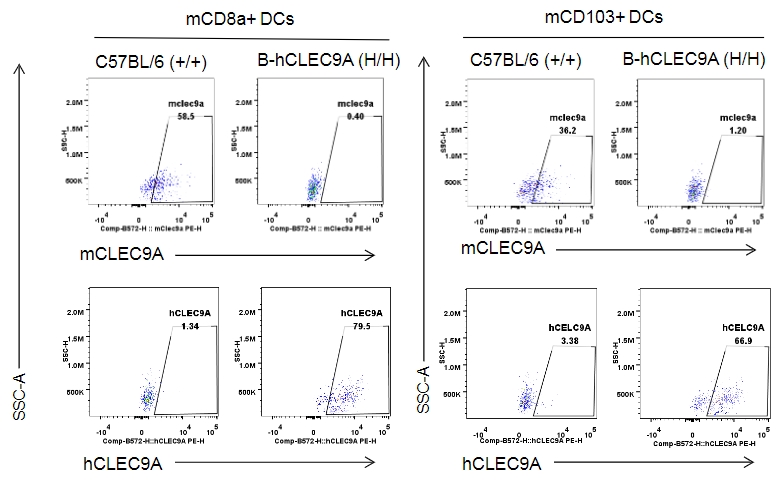
- Human CLEC9A was specifically detected on splenic cDC1 subsets (mCD8α+ and mCD103+ DCs) of homozygous CLEC9A humanized mice but not in wild-type mice.
- Mouse CLEC9A was specifically detected on splenic cDC1 subsets (mCD8α+ and mCD103+ DCs) of wild-type mice but not in homozygous CLEC9A humanized mice.
Strain specific CLEC9A expression analysis in homozygous CLEC9A humanized mice by flow cytometry. Splenocytes were collected from wild-type C57BL/6 mice (+/+) and homozygous B-hCLEC9A mice (H/H). CLEC9A expression on splenocytes was analyzed by flow cytometry using anti-mouse CLEC9A antibody (Biolegend, 143503) and anti-human CLEC9A antibody (Biolegend, 353803).
Animal State Evaluation-Leukocyte Profiling in in Spleen of CLEC9A Humanized Mice
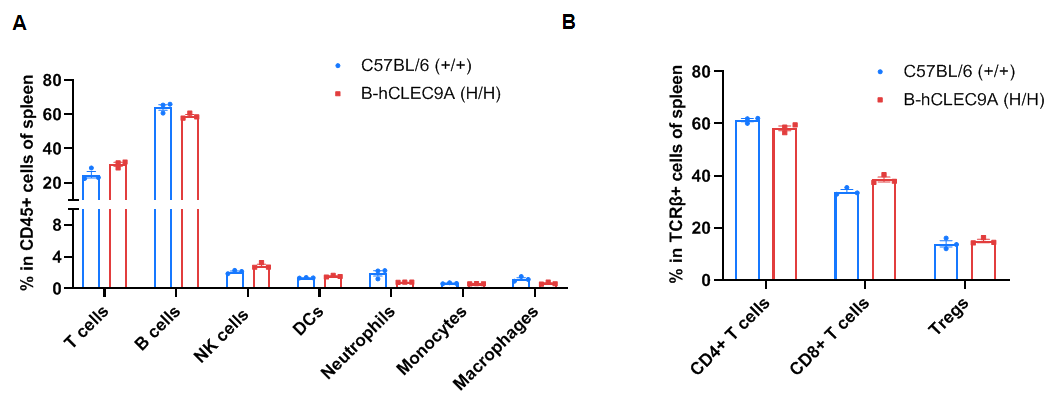
- Frequencies of T cells, B cells, NK cells, DCs, neutrophils, monocytes, macrophages, CD4+ T cells, CD8+ T cells and Tregs in homozygous CLEC9A humanized mice were similar to those in C57BL/6 mice, demonstrating that humanization of CLEC9A dose not change the frequency or distribution of these cell types in spleen.
- The frequency of leukocyte subpopulations in blood and lymph node of CLEC9A humanized mice were also comparable to wild-type C57BL/6 mice (Data not shown).
Frequency of leukocyte subpopulations in spleen by flow cytometry. Splenocytes were isolated from wild-type C57BL/6 mice and homozygous B-hCLEC9A mice (female, 6-week-old, n=3). (A) Flow cytometry analysis of the splenocytes was performed to assess the frequency of leukocyte subpopulations. (B) Frequency of T cell subpopulations. Values are expressed as mean ± SEM.
* When publishing results obtained using this animal model, please acknowledge the source as follows: The animal model [B-hCLEC9A mice] (Cat# 111994) was purchased from Biocytogen.