C57BL/6-Il4tm2(IL4)Bcgen Il4ratm1(IL4RA)BcgenTslptm1(TSLP)Bcgen Crlf2tm2(CRLF2)Bcgen/Bcgen • 112954
on this page

Key Advantages
Validation
Application

Exons 1-5 of mouse Tslp encoding the full-length protein were replaced by human TSLP exons 1-4 in B-hTSLP/hTSLPR mice. The signal peptide, extracellular, and transmembrane regions of human TSLPR and the cytoplasmic region of mouse Tslpr were constructed into a chimeric CDS vector and inserted into mouse exon 2, enabling expression of chimeric TSLPR protein. Exons 1-4 of mouse Il4 encoding the full-length coding sequence were replaced by human IL4 exons 1-4 in B-hIL4/hIL4RA mice. Exons 4-7 of mouse Il4ra encoding extracellular-region coding sequences were replaced by human IL4RA exons 4-7. B-hIL4/hIL4RA/hTSLP/hTSLPR mice were developed by cross-mating B-hTSLP/hTSLPR mice with B-hIL4/hIL4RA mice.


Strain-specific IL4 expression analysis in wild-type C57BL/6JNifdc mice and homozygous B-hIL4/hIL4RA/hTSLP/hTSLPR mice by ELISA. Serum was collected from wild-type C57BL/6JNifdc mice and homozygous B-hIL4/hIL4RA/hTSLP/hTSLPR mice stimulated with anti-mouse CD3ε (7.5 μg/mice, i.p.) in vivo for 4 hrs, and analyzed by ELISA with species-specific IL4 ELISA kits (mIL4 kit: BioLegend 431104; hIL4 kit: BioLegend 430304). Human IL4 was detectable in homozygous B-hIL4/hIL4RA/hTSLP/hTSLPR mice.
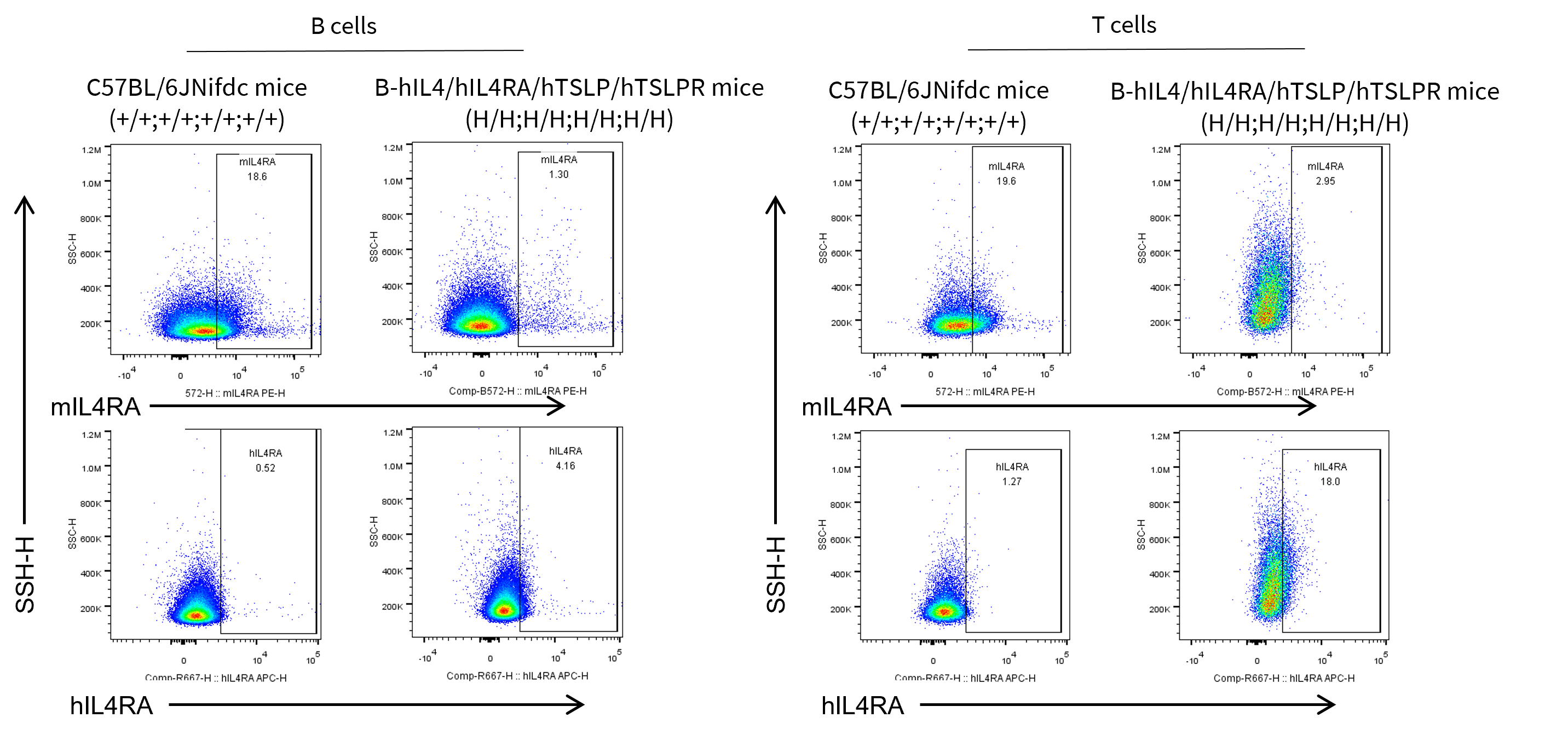
Strain-specific IL4RA expression analysis in wild-type C57BL/6JNifdc mice and homozygous humanized B-hIL4/hIL4RA/hTSLP/hTSLPR mice by flow cytometry. Protein expression was analyzed with anti-human IL4RA antibody (BD, 552178) by flow cytometry. Human IL4RA was detectable in homozygous B-hIL4/hIL4RA/hTSLP/hTSLPR mice.

Strain-specific TSLP expression analysis in wild-type C57BL/6JNifdc mice and homozygous B-hIL4/hIL4RA/hTSLP/hTSLPR mice by ELISA. Mouse and human TSLP levels were analyzed by ELISA (mouse TSLP ELISA kit: BioLegend 434107; human TSLP ELISA kit: BioLegend 434207). Human TSLP was detectable in homozygous B-hIL4/hIL4RA/hTSLP/hTSLPR mice.
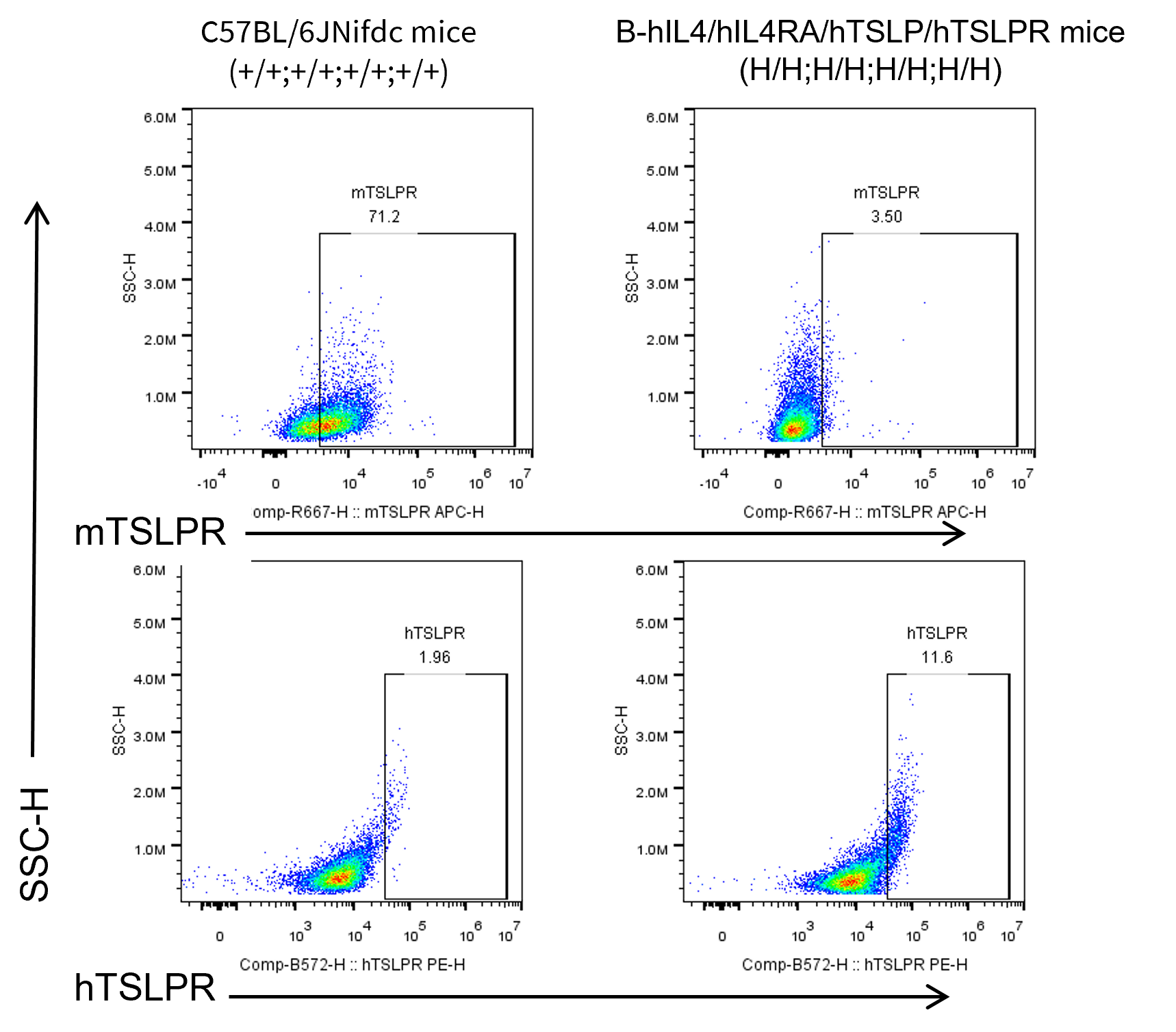
Strain-specific TSLPR expression analysis in wild-type C57BL/6JNifdc mice and homozygous humanized B-hIL4/hIL4RA/hTSLP/hTSLPR mice by flow cytometry. Protein expression was analyzed with anti-mouse TSLPR antibody (BioLegend, 151805) and anti-human TSLPR antibody (BioLegend, 322805) by flow cytometryHuman TSLPR was detectable in homozygous B-hIL4/hIL4RA/hTSLP/hTSLPR mice.
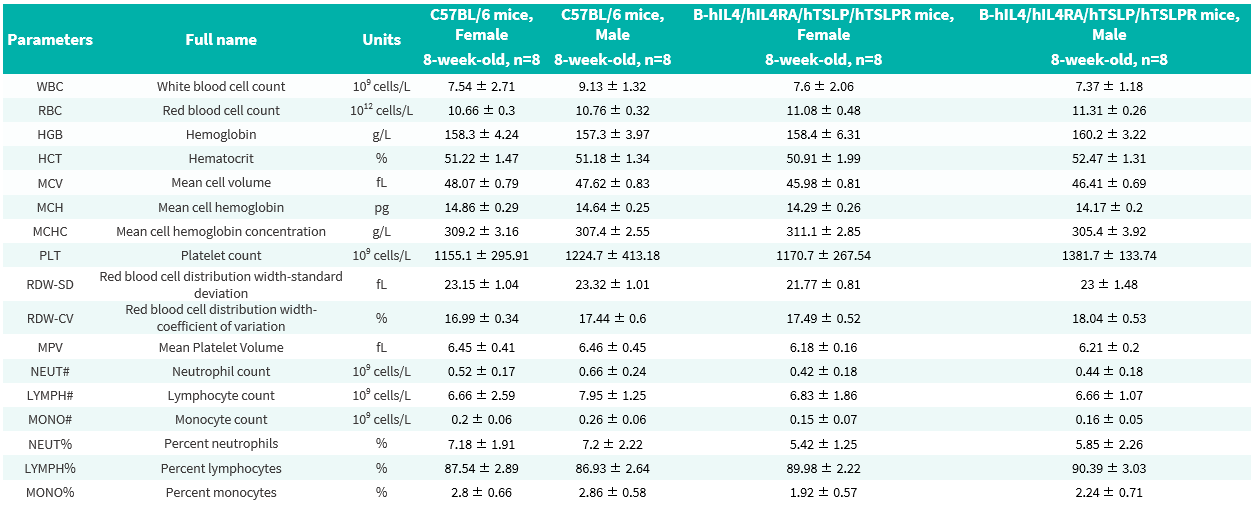
Complete blood count (CBC) of B-hIL4/hIL4RA/hTSLP/hTSLPR mice. Hematology parameters were measured to evaluate baseline physiological status of the model.
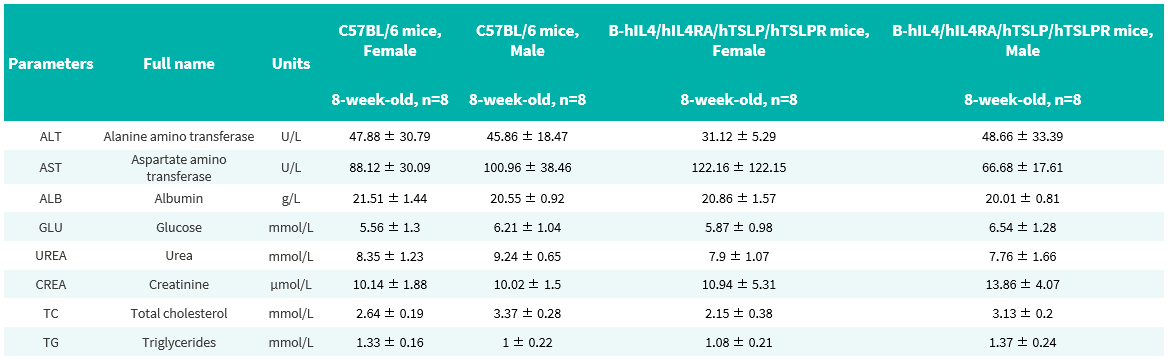
Biochemical test of B-hIL4/hIL4RA/hTSLP/hTSLPR mice. Serum biochemical parameters were measured to support baseline physiological characterization of B-hIL4/hIL4RA/hTSLP/hTSLPR mice.
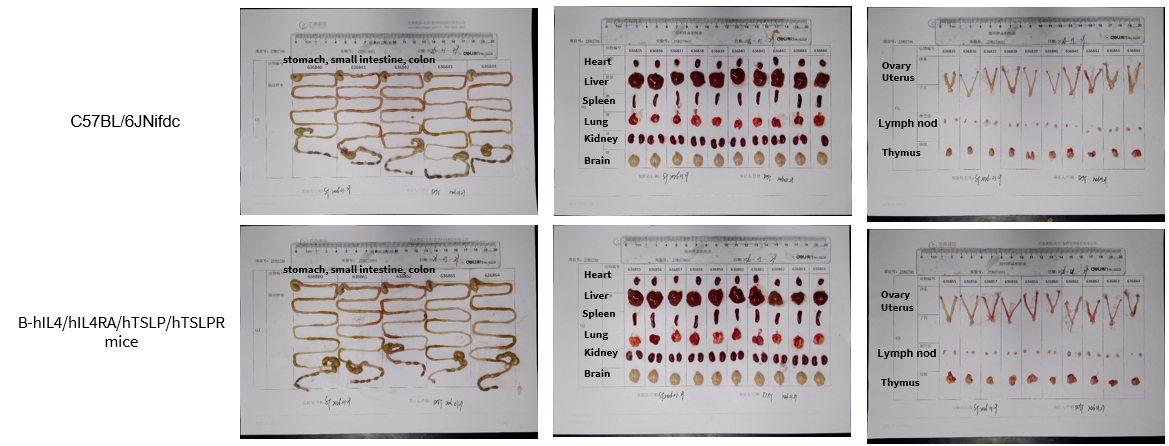
Gross anatomy of female C57BL/6JNifdc and B-hIL4/hIL4RA/hTSLP/hTSLPR mice. The organs of female C57BL/6JNifdc and B-hIL4/hIL4RA/hTSLP/hTSLPR mice were collected at 12 weeks of age (n=10) for anatomical assessment.
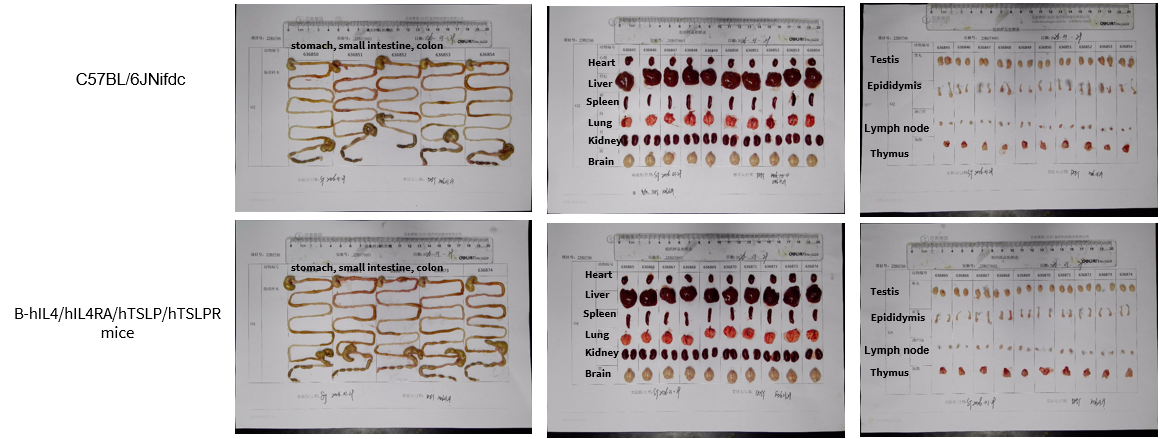
Gross anatomy of male C57BL/6JNifdc and B-hIL4/hIL4RA/hTSLP/hTSLPR mice. The organs of male C57BL/6JNifdc and B-hIL4/hIL4RA/hTSLP/hTSLPR mice were collected at 12 weeks of age (n=10) for anatomical assessment.
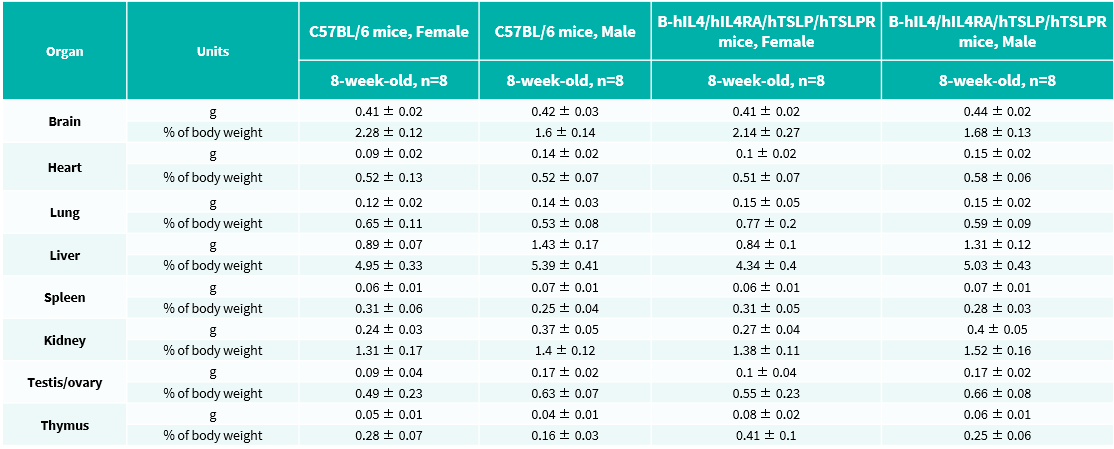
Average weight of the main organs of female and male C57BL/6JNifdc and B-hIL4/hIL4RA/hTSLP/hTSLPR mice. Organ weight analysis provides baseline physiological information for B-hIL4/hIL4RA/hTSLP/hTSLPR plus mice.
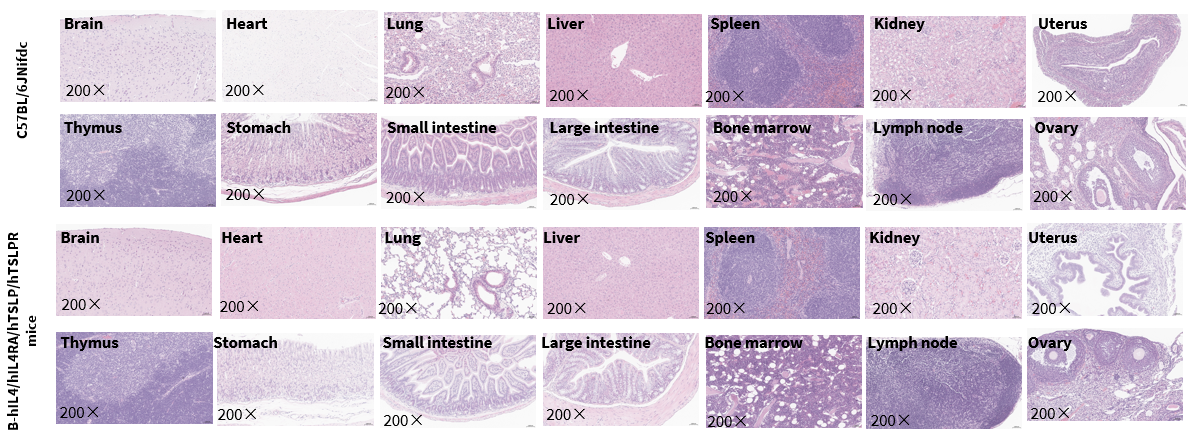
Histopathological analysis of organs in female C57BL/6JNifdc and B-hIL4/hIL4RA/hTSLP/hTSLPR mice. Main organs were isolated at 12 weeks of age and analyzed with H&E staining. Results showed that no obvious abnormalities were found in the examined organs, including heart, liver, spleen, lung, kidney, brain, stomach, small intestine, large intestine, thymus, lymph nodes, uterus, and ovary.
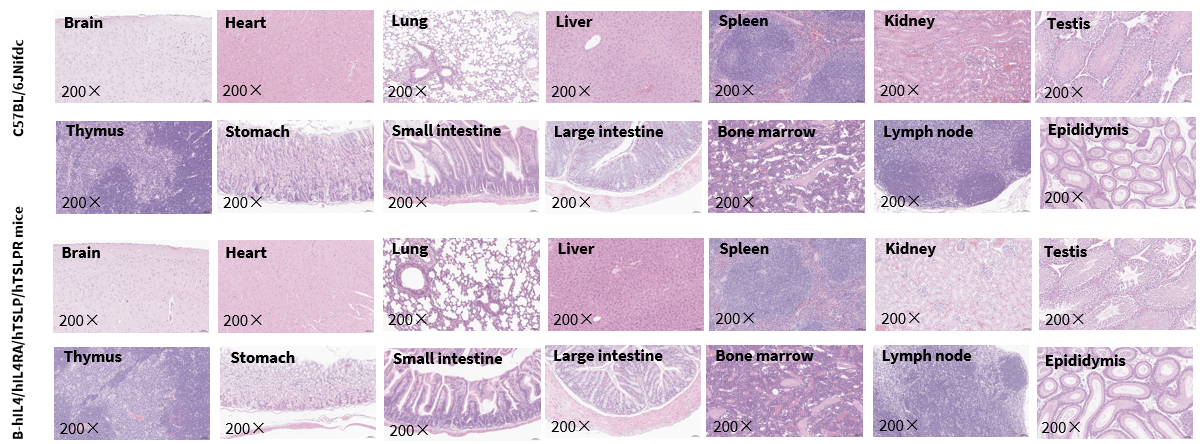
Histopathological analysis of organs in male C57BL/6JNifdc and B-hIL4/hIL4RA/hTSLP/hTSLPR mice. Main organs were isolated at 12 weeks of age and analyzed with H&E staining. Results showed that no obvious abnormalities were found in the examined organs, including heart, liver, spleen, lung, kidney, brain, stomach, small intestine, large intestine, thymus, lymph nodes, testis, and epididymis.

Q1: What are B-hIL4/hIL4RA/hTSLP/hTSLPR mice?
B-hIL4/hIL4RA/hTSLP/hTSLPR mice are multi-gene humanized mice developed by Biocytogen for type 2 inflammation, asthma, and atopic dermatitis research.
Q2: How was human IL4, IL4RA, TSLP, and TSLPR expression validated in this mouse model?
Human IL4, IL4RA, TSLP, and TSLPR expression were validated using ELISA or flow cytometry in serum, splenocytes, ear tissue, and bone marrow-derived dendritic cells.
Q3: What applications are supported by B-hIL4/hIL4RA/hTSLP/hTSLPR mice?
B-hIL4/hIL4RA/hTSLP/hTSLPR mice support anti-human IL4RA antibody evaluation, anti-human TSLP antibody evaluation, combination therapy studies, asthma models, AD models, and type 2 inflammation research.