Description
- Gene Information: C9 is a constituent of the complement system acting at the very end of the complement cascade. Its primary role is to drive the formation of the membrane attack complex (MAC), which punches large pores into the membranes of target bacteria, enveloped viruses, and parasites, resulting in cytolysis.
- Protein Expression: It is constitutively expressed mainly in the liver under physiological conditions to maintain the complement level in blood.
- Signaling Pathway: C9 is involved in MAC formation during the terminal step of the complement cascade, a process that is common to all three complement activation pathways
- Therapeutic Inhibition: Targeting C9 with therapeutic agents such as monoclonal antibodies, siRNAs, and small-molecule inhibitors to prevent MAC assembly represents a promising therapeutic strategy for immuno-inflammatory and neurodegenerative diseases.
Targeting strategy
Gene targeting strategy for B-hC9 mice.
- The exons 1~11 of mouse C9 gene that encode the whole molecule (ATG to STOP codon) were replaced by human counterparts in B-hC9 mice.
- The promoter and 5’UTR region of the mouse gene are retained, and the mouse 3’UTR is replaced by the human 3’UTR.
- The human C9 protein expression is driven by endogenous mouse C9 promoter.
mRNA expression analysis by RT-PCR
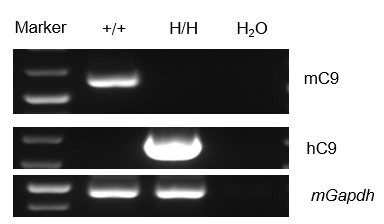
- Human C9 mRNA was detectable only in homozygous B-hC9 mice but not in wild-type mice.
Strain specific analysis of C9 mRNA expression in wild-type C57BL/6JNifdc mice and B-hC9 mice by RT-PCR. Liver RNA were isolated from wild-type C57BL/6JNifdc mice (+/+) and homozygous B-hC9 mice (H/H), then cDNA libraries were synthesized by reverse transcription, followed by PCR with mouse and human C9 primers. Mouse C9 mRNA was only detectable in wild-type mice. Human C9 mRNA was detectable only in homozygous B-hC9 mice but not in wild-type mice.
C9 Protein Expression Analysis
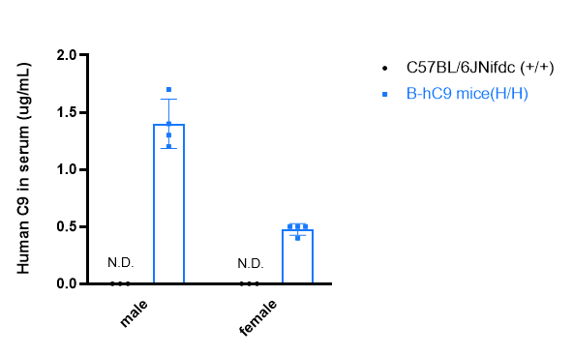
- Human C9 was detected in homozygous B-hC9 mice, but not in wild-type mice.
Strain specific C9 expression analysis in wild-type C57BL/6 mice and homozygous humanized B-hC9 mice by ELISA. Serum were collected from C57BL/6JNifdc mice (n=6, 8 weeks old, 3 male and 3 female) and B-hC9 mice (male,n=4, 12 weeks old; female,n=4, 37 weeks old) . Expression level of human C9 was analyzed by ELISA (Anti-C9 ELISA kit: abcam, ab287178). Values are expressed as mean ± SD.
* When publishing results obtained using this animal model, please acknowledge the source as follows: The animal model [B-hC9 mice] (Cat# 111485) was purchased from Biocytogen.