Description
RGMC: A key BMP co-receptor in iron homeostasis and its therapeutic intervention
- Gene Information: Repulsive guidance molecule C (RGMC, also termed hemojuvelin/HJV, encoded by HFE2) is a protein-coding gene located on chromosome 1q21.1. It encodes a GPI-anchored membrane glycoprotein of the RGM protein family.
- Protein Expression: Membrane-bound RGMC is predominantly produced by hepatocytes, muscle and cardiac cells; it is proteolytically cleaved into soluble form and released into circulation under iron fluctuation or inflammatory stress.
- Signaling Pathway: As a BMP co-receptor, RGMC potentiates BMP2/6-SMAD1/5/8 signaling to transcriptionally activate hepcidin, restricting intestinal iron absorption and macrophage iron release to maintain systemic iron homeostasis.
- Therapeutic Inhibition: Anti-RGMC mAbs block BMP-RGMC binding to suppress hepatic hepcidin synthesis and mobilize stored tissue iron, treating functional iron deficiency with lower iron overload risk than conventional iron therapies.
Targeting strategy
- The exons 1~4 of mouse Hjv gene that encodes the full-length protein was replaced by human HJV exons 1~4 in B-hRGMc mice.
- The 5’UTR and 3’UTR region of the mouse gene are replaced by human counterparts.
- The human HJV expression is driven by human HJV promoter, while mouse Hjv gene transcription and translation will be disrupted.
mRNA expression analysis
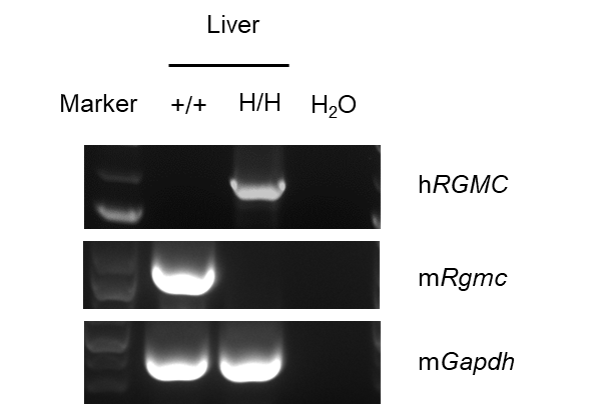
- Mouse Rgmc mRNA was only detectable in wild-type mice.
- Human RGMC mRNA was only detectable in homozygous B-hRGMc mice.
Strain specific analysis of RGMC mRNA expression in wild-type C57BL/6JNifdc mice and homozygous B-hRGMc mice by RT-PCR. Liver RNA were isolated from wild-type C57BL/6JNifdc mice (+/+) and homozygous B-hRGMc mice (H/H), then cDNA libraries were synthesized by reverse transcription, followed by PCR with mouse and human primers.
RGMc Protein Expression Analysis
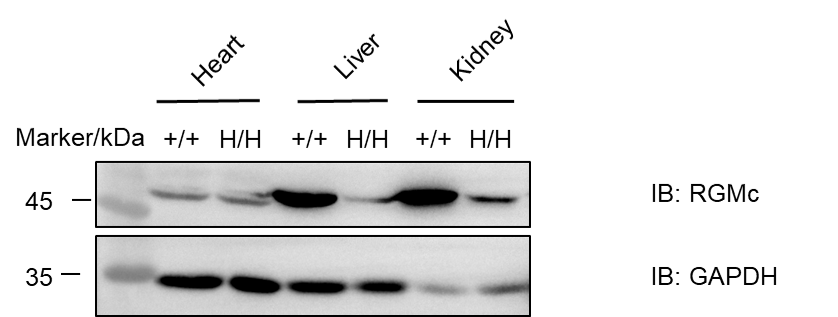
- The RGMc protein was detectable in heart, liver, and kidney of wild-type C57BL/6JNifdc mice or homozygous B-hRGMc mice, as the antibody is cross-reactive between human and mouse RGMc.
Western blot analysis of RGMc protein expression in homozygous B-hRGMc mice. Various tissue lysates were collected from wild-type C57BL/6JNifdc mice (+/+) and homozygous B-hRGMc mice (H/H), and then analyzed by western blot with anti-RGMc antibody (Proteintech, 11758-1-AP). 40 μg total protein was loaded for western blotting analysis.
Functional validation
- The serum total iron content is similar in wild-type C57BL/6JNifdc mice and homozygous B-hRGMc mice, indicating humanized RGMc functions well.
Analysis of Serum total iron in homozygous B-hRGMc mice by ELISA. Serum were collected from wild-type C57BL/6JNifdc mice (male, n=3, 10-week-old) and homozygous B-hRGMc mice (male, n=3, 5-week-old). Total iron in serum was analyzed by ELISA with Iron Assay Kit (Abcam, ab83366). The serum total iron content is similar in wild-type C57BL/6JNifdc mice and homozygous B-hRGMc mice. Significance was determined by multiple t tests.
* When publishing results obtained using this animal model, please acknowledge the source as follows: The animal model [B-hRGMc mice] (Cat# 112627) was purchased from Biocytogen.