
Background
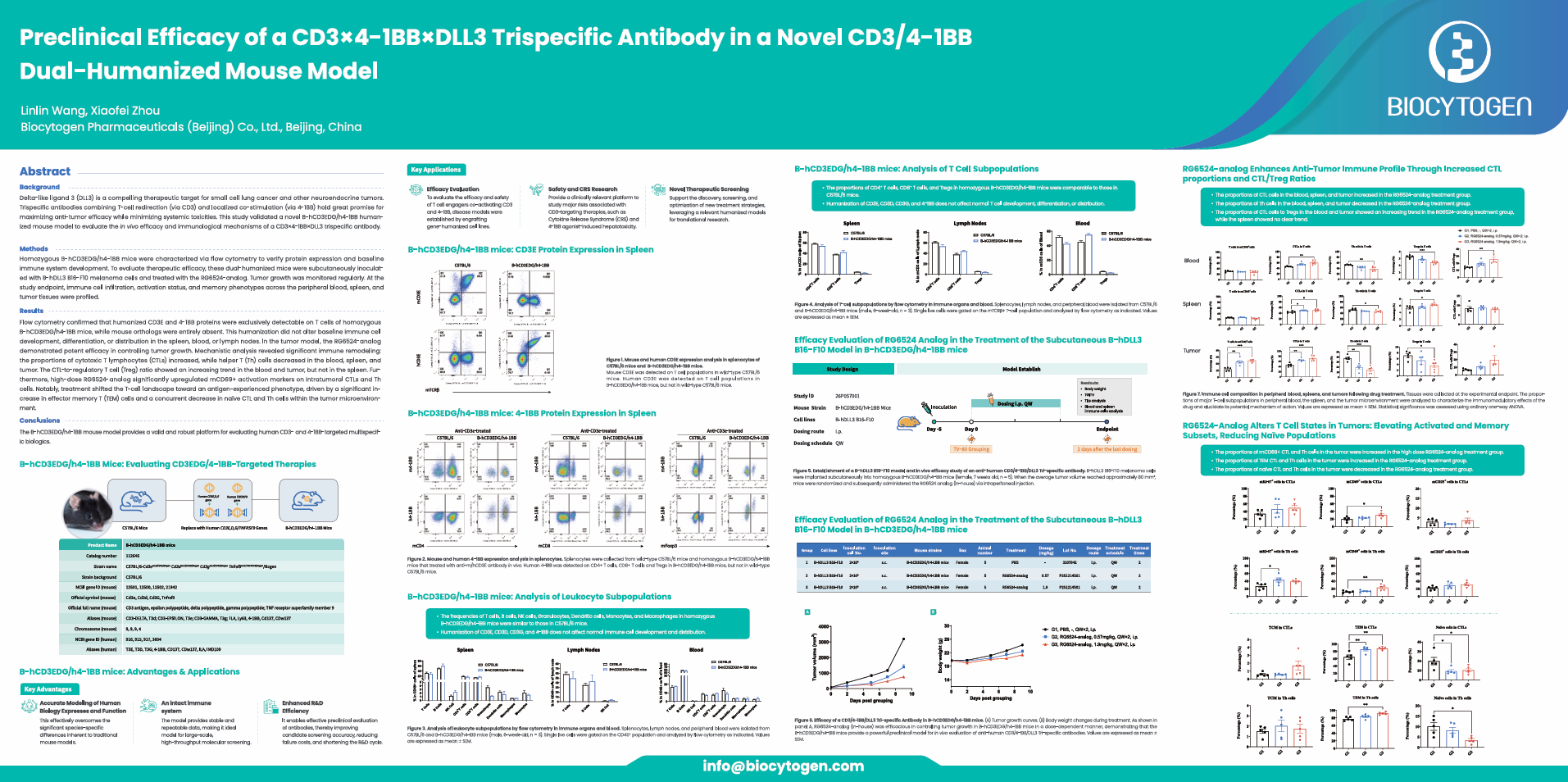
Delta-like ligand 3 (DLL3) is a compelling therapeutic target for small cell lung cancer and other neuroendocrine tumors. Trispecific antibodies combining T-cell redirection (via CD3) and localized co-stimulation (via 4-1BB) hold great promise for maximizing anti-tumor efficacy while minimizing systemic toxicities. This study validated a novel B-hCD3EDG/h4-1BB humanized mouse model to evaluate the in vivo efficacy and immunological mechanisms of a CD3x4-1BBxDLL3 trispecific antibody.
Methods
Homozygous B-hCD3EDG/h4-1BB mice were characterized via flow cytometry to verify protein expression and baseline immune system development. To evaluate therapeutic efficacy, these dual-humanized mice were subcutaneously inoculated with B-hDLL3 B16-F1O melanoma cells and treated with the RG6524-analog. Tumor growth was monitored regularly. At the study endpoint, immune cell infiltration, activation status, and memory phenotypes across the peripheral blood, spleen, and tumor tissues were profiled.
Results
Flow cytometry confirmed that humanized CD3E and 4-1BB proteins were exclusively detectable on T cells of homozygous B-hCD3EDG/h4-1BB mice, while mouse orthologs were entirely absent. This humanization did not alter baseline immune cell development, differentiation, or distribution in the spleen, blood, or lymph nodes. In the tumor model, the RG6524-analog demonstrated potent efficacy in controlling tumor growth. Mechanistic analysis revealed significant immune remodeling: the proportions of cytotoxic T lymphocytes (CTLs) increased, while helper T (Th) cells decreased in the blood, spleen, and tumor. The CTL-to-regulatory T cell (Treg) ratio showed an increasing trend in the blood and tumor, but not in the spleen. Furthermore, high-dose RG6524-analog significantly upregulated mCD69+ activation markers on intratumoral CTLs and Th cells. Notably, treatment shifted the T-cell landscape toward an antigen-experienced phenotype, driven by a significant increase in effector memory T (TEM) cells and a concurrent decrease in naive CTL and Th cells within the tumor microenvironment.
Conclusion
The B-hCD3EDG/h4-1BB mouse model provides a valid and robust platform for evaluating human CD3- and 4-1BB-targeted multispecific biologics.