
Background
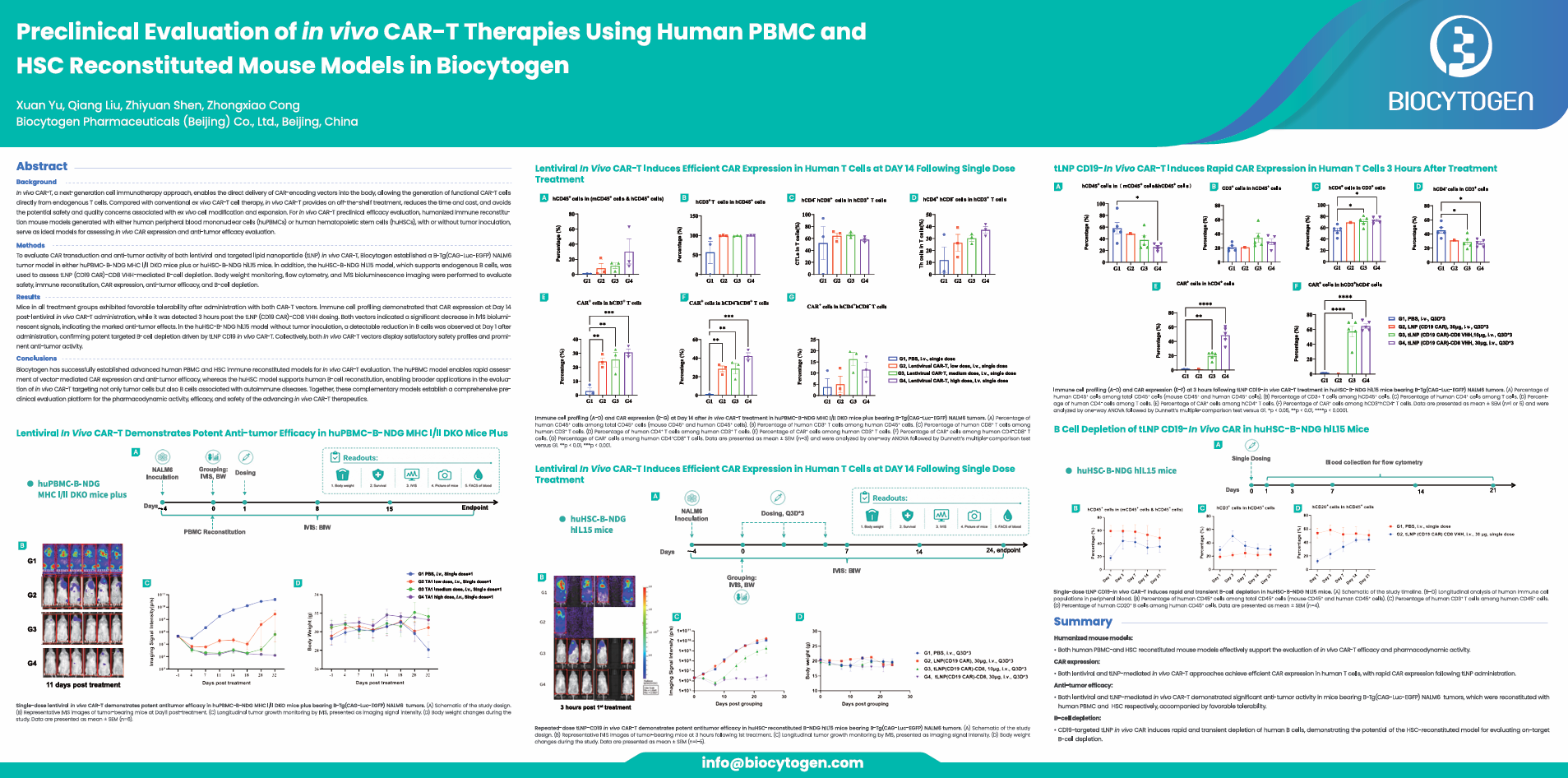
In vivo CAR-T, a next-generation cell immunotherapy approach, enables the direct delivery of CAR-encoding vectors into the body, allowing the generation of functional CAR-T cells directly from endogenous T cells. Compared with conventional ex vivo CAR-T cell therapy, in vivo CAR-T provides an off-the-shelf treatment, reduces the time and cost, and avoids the potential safety and quality concerns associated with ex vivo cell modification and expansion. For in vivo CAR-T preclinical efficacy evaluation, humanized immune reconstitution mouse models generated either human peripheral blood mononuclear cells (huPBMCs) or human hematopoietic stem cells (huHSCs), with or without tumor inoculation, serve as ideal models for assessing in vivo CAR expression and anti-tumor efficacy evaluation.
Methods
To evaluate CAR transduction and anti-tumor activity of both lentiviral and targeted lipid nanoparticle (tLNP) in vivo CAR-T, Biocytogen established a B-Tg(CAG-Luc-EGFP) NALM6 tumor model in either huPBMC-B-NDG MHC I/II DKO mice plus or huHSC-B-NDG hlL15 mice. In addition, the huHSC-B-NDG hlL15 model, which supports endogenous B cells, was used to assess tLNP (CD19 CAR)-CD8 VHH-mediated B-cell depletion. Body weight monitoring, flow cytometry, and IVIS bioluminescence imaging were performed to evaluate safety, immune reconstitution, CAR expression, anti-tumor efficacy, and B-cell depletion.
Results
Mice in all treatment groups exhibited favorable tolerability after administration with both CAR-T vectors. Immune cell profiling demonstrated that CAR expression at Day 14 post-lentiviral in vivo CAR-T administration, while it was detected 3 hours post the tLNP (CD19 CAR)-CD8 VHH dosing. Both vectors indicated a significant decrease in IVIS bioluminescent signals, indicating the marked anti-tumor effects. In the huHSC-B-NDG hlL15 model without tumor inoculation, a detectable reduction in B cells was observed at Day 1 after administration, confirming potent targeted B-cell depletion driven by tLNP CD19 in vivo CAR-T. Collectively, both in vivo CAR-T vectors display satisfactory safety profiles and prominent anti-tumor activity
Conclusions
Biocytogen has successfully established advanced human PBMC and HSC immune reconstituted models for in vivo CAR-T evaluation. The huPBMC model enables rapid assessment of vector-mediated CAR expression and anti-tumor efficacy, whereas the huHSC model supports human B-cell reconstitution, enabling broader applications in the evaluation of in vivo CAR-T targeting not only tumor cells but also B cells associated with autoimmune diseases. Together, these complementary models establish a comprehensive preclinical evaluation platform for the pharmacodynamic activity, efficacy, and safety of the advancing in vivo CAR-T therapeutics.