
on this page

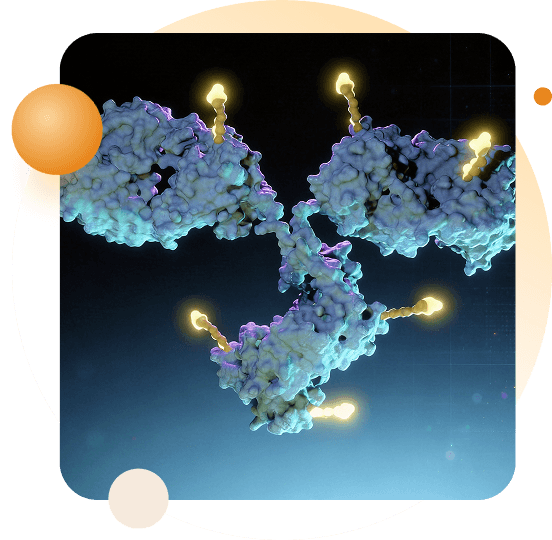
Built on the RenLite® platform, this fully human IgG1κ bispecific antibody utilizes common light chain technology to minimize heavy/light chain mispairing, ensure seamless assembly, simplify manufacturing, and provide a developable backbone for B7-H4 × TROP2 bispecific ADC development.
The B7-H4 × TROP2 bispecific ADC is conjugated with Biocytogen's proprietary BLD1102 linker–payload system containing BCPT02, a topoisomerase I (TOP1) inhibitor, designed to drive potent ADC-mediated cytotoxicity in solid tumor drug development.
The B7-H4 × TROP2 bispecific ADC is being evaluated as a preclinical asset for B7-H4/TROP2 dual-positive solid tumors, with potential indications including ovarian cancer, cholangiocarcinoma, lung cancer, and breast cancer.

The preclinical data package for the B7-H4 × TROP2 bispecific ADC, generated through Biocytogen’s internal studies, includes cross-species target binding, cellular internalization, preferential binding to dual-high tumor cells, in vitro cytotoxicity, developability assessments, and antitumor efficacy in breast cancer CDX and PDX models. Together, these data support further development of the BCPT02-conjugated DAR4 ADC as a differentiated dual-targeting approach for B7-H4/TROP2-expressing solid tumors.
(Representative data shown; full data package available upon request.)
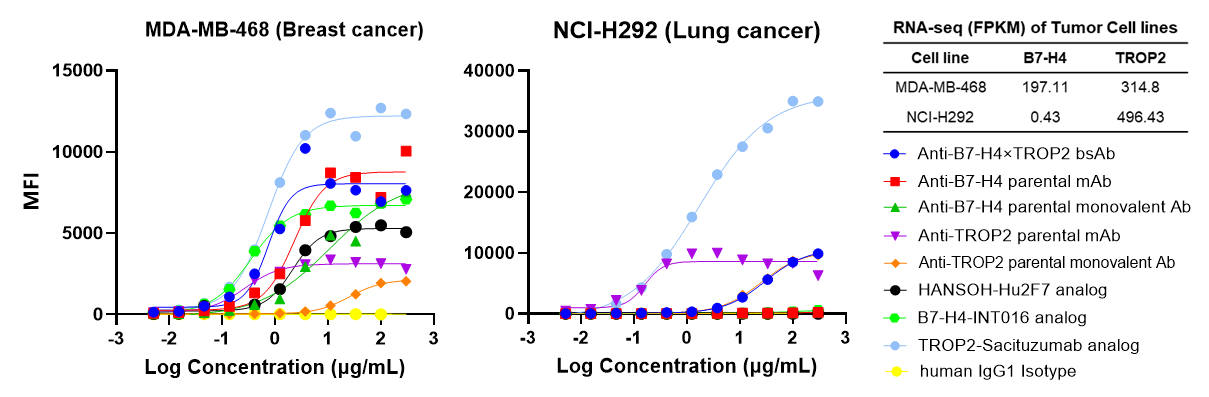
Figure 1. Binding of the B7-H4 × TROP2 bispecific antibody to dual-expressing and TROP2 single-positive tumor cells. The bispecific antibody demonstrated concentration-dependent binding to B7-H4/TROP2 dual-high MDA-MB-468 breast cancer cells. In B7-H4-negative/TROP2-high NCI-H292 lung cancer cells, its binding curve was shifted toward higher concentrations, with lower binding signals than the anti-TROP2 parental antibody at low-to-intermediate concentrations. These results are consistent with preferential binding to dual-high tumor cells, supporting the design rationale for enhanced tumor selectivity. The antibody also demonstrated nanomolar affinity for human and cynomolgus monkey B7-H4 and TROP2, alongside moderate cellular internalization.
(Detailed cross-species affinity profiles, internalization assessments, and additional cellular binding data are available in the full data package upon request.)
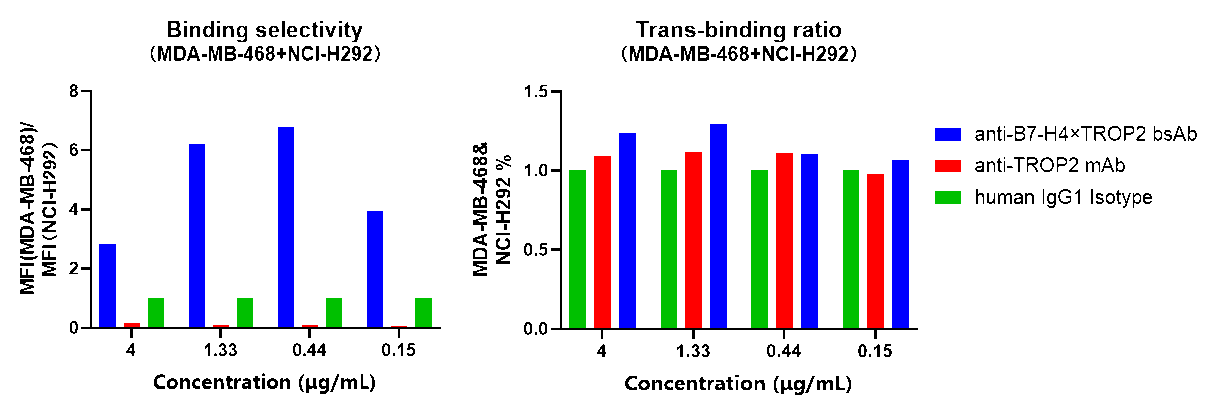
Figure 2. Binding selectivity and trans-binding assessment of the B7-H4 × TROP2 bispecific antibody. B7-H4/TROP2 dual-high MDA-MB-468 cells were mixed with B7-H4-negative/TROP2-high NCI-H292 cells at a 1:10 ratio. Across the tested concentrations, the bispecific antibody showed preferential binding to dual-high MDA-MB-468 cells compared with the anti-TROP2 parental antibody (left). Trans-binding ratios remained close to those of the human IgG1 isotype control (right).
(Additional in vitro cytotoxicity data, including dose-response curves and IC50 comparisons with parental ADCs, are available in the full data package upon request.)
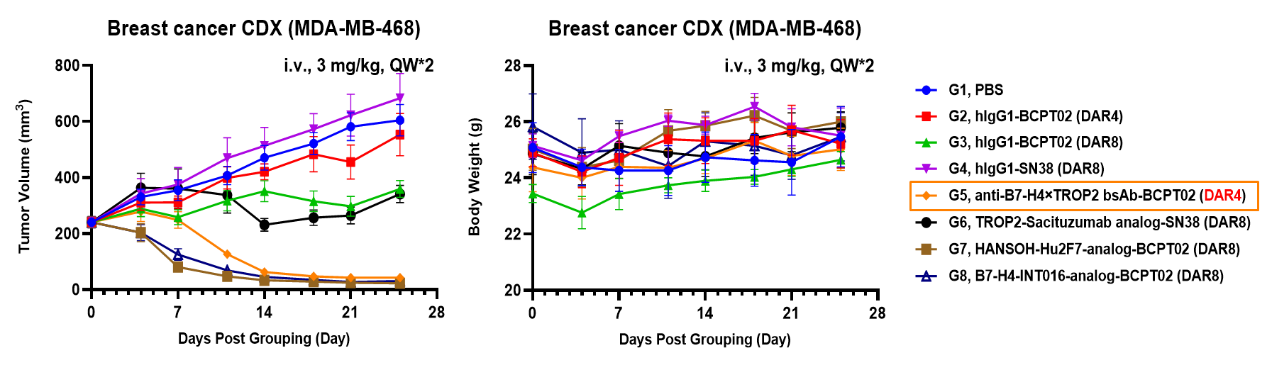
Figure 3. Antitumor efficacy and body weight in the MDA-MB-468 breast cancer CDX model. Tumor-bearing B-NDG mice received intravenous treatment at 3 mg/kg once weekly for two doses. The BCPT02-conjugated B7-H4 × TROP2 bispecific ADC (DAR4) induced sustained tumor regression. Its antitumor activity exceeded that of the TROP2–sacituzumab analog–SN38 (DAR8) and was comparable to that of two DAR8 benchmarks: HANSOH-Hu2F7 analog–BCPT02 and B7-H4–INT016 analog–BCPT02. Body weight was generally maintained, supporting preliminary tolerability under the tested conditions.
(Additional breast cancer PDX efficacy and corresponding body weight data, along with antibody biophysical properties and stability assessments under stress conditions, are available in the full data package upon request.)

Biocytogen welcomes partnership discussions to further evaluate this B7-H4 × TROP2 bispecific ADC asset.

This fully human bispecific ADC combines B7-H4 tumor selectivity with broad TROP2 tumor coverage. Its dual-targeting design is intended to favor engagement of B7-H4/TROP2 dual-high tumor cells, potentially helping address antigen heterogeneity and challenges associated with TROP2 expression in normal tissues. Preclinical studies demonstrated preferential binding to dual-high tumor cells and robust antitumor activity at DAR4. Body weight was generally maintained in the breast cancer CDX model, providing a preliminary tolerability observation, while PK profiling and further in vivo selectivity and toxicity assessments are ongoing.
The B7-H4 × TROP2 bispecific ADC incorporates Biocytogen’s proprietary BLD1102 linker–payload system with the BCPT02 topoisomerase I (TOP1) inhibitor payload. The system is designed to support potent cytotoxicity, controlled payload release, favorable hydrophilicity, circulation stability, and overall ADC developability.
The B7-H4 × TROP2 bispecific ADC is built on Biocytogen's proprietary RenLite® platform. It utilizes a fully human IgG1κ common-light-chain backbone that delivers high binding affinity and strong developability. This advanced engineering minimizes the risk of chain mispairing, supporting efficient and scalable CMC manufacturing for clinical development.
This preclinical asset is available for licensing and co-development. The full data package includes binding profiles against human and cynomolgus monkey targets, cellular binding and internalization, mixed-cell binding selectivity, in vitro cytotoxicity, antibody biophysical properties and stability assessments, and antitumor efficacy in breast cancer CDX and PDX models. PK profiling and further in vivo selectivity and toxicity assessments are ongoing. Contact Biocytogen to request the complete data package or discuss potential licensing and co-development opportunities.